
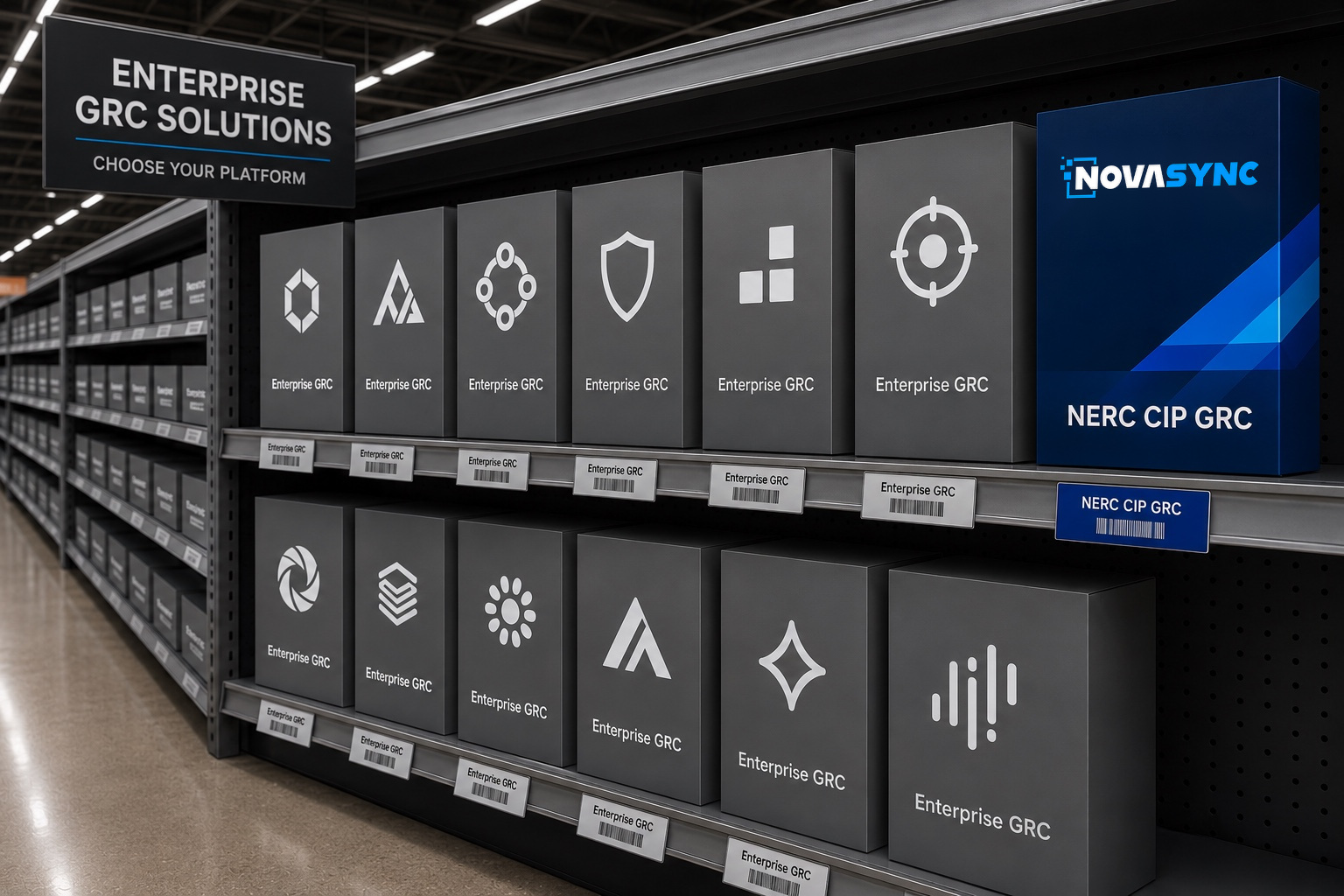
If you work at utility in North America, you already know NERC CIP compliance is not just about “managing controls.”
It is evidence requests. Recurring tasks. Asset lists. BES Cyber System categorizations. Access reviews. Change records. Exception tracking. Internal controls. Audit prep. Mitigation activity. Procedure updates. SME follow-ups. More SME follow-ups. Screenshots. Approvals. Attestations. Quarterly access reviews. Patching. And the constant pressure of knowing that if something is missed, incomplete, late, or poorly documented, it can become a finding.
That is the reality of NERC CIP.
So when someone says, “We already have a GRC platform,” the real question is not whether the organization owns compliance software.
The real question is: does that software actually help you manage NERC CIP?
For many utilities, the answer is no.
A generic enterprise GRC may help with corporate risk, policy management, audits, issue tracking, or general compliance activities. But NERC CIP is different. It has its own language, timelines, evidence expectations, asset relationships, audit practices, security controls, and operational dependencies. A generic enterprise GRC can usually be heavily customized to support some of that work, but customization is not the same as having a platform built for the way NERC CIP compliance actually operates.
That is why utilities need a focused NERC CIP GRC workflow platform, even if they already have an enterprise GRC. Let’s dig into the why behind this concept.
NERC CIP Work Is Not Generic Compliance Work
Most people outside of the CIP program underestimate how detailed the work really is.
NERC CIP is not simply a list of requirements that can be assigned to control owners once a year. It is an active compliance program that touches cyber assets, physical security, electronic access, personnel risk, training, configuration change management, vulnerability assessments, incident response, recovery planning, supply chain risk management, and information protection.
The hard part is not just knowing what the standard says. The hard part is proving that your utility consistently performed the required compliance activities, at the right time, with the right scope, with the right approvals, and with evidence that can stand up to audit review.
That is where generic GRC platforms often struggle.
They may give you a place to create controls, assign tasks, and upload evidence. But they do not automatically understand how CIP-002 drives asset scope, how CIP-004 access management workflows connect to personnel changes, how CIP-010 change management evidence needs to tie back to baseline information, or how CIP-011 affects where sensitive BES Cyber System Information (BCSI) should live.
For a CIP practitioner, those details matter every day.
The Problem With Customizing Generic GRC Tools
Generic GRC tools are often sold on flexibility. In theory, that sounds useful. In practice, for NERC CIP teams, flexibility often means the utility has to build everything itself.
Someone has to translate the CIP standards into the platform. Someone has to define the workflows. Someone has to create the evidence request process. Someone has to map requirements to responsible teams. Someone has to connect various systems together for evidence collection. Someone has to configure dashboards, reminders, approvals, exceptions, reporting, and audit packages.
And that “someone” is usually the same small compliance team that is already overloaded.
The result is that the utility does not really buy a NERC CIP focused solution. It buys a generic platform and then takes on the project of turning it into a NERC CIP solution.
That can work, but it comes with real cost. It takes time. It requires specialized knowledge. It depends heavily on consultants or internal power users. And every workflow decision introduces the possibility that something important gets missed because the platform was not designed around CIP in the first place.
A purpose-built NERC CIP management tool starts from a different place. It is designed around the actual work CIP compliance teams and their SMEs need to perform. The structure, workflows, terminology, and evidence model are already aligned to the compliance program.
That means the CIP team can spend less time building the system and more time actually managing their compliance program.
A NERC CIP Management Tool Should Understand Your Program
If you work in CIP compliance, you know that small details can create big problems.
A task that is assigned to the wrong owner can sit unresolved. An evidence request without clear scope can produce incomplete documentation. An asset change can affect multiple requirements. A missed approval can turn a good control activity into a weak audit position. A file stored in the wrong place can create BCSI concerns.
A generic GRC platform may not know enough to prevent these types of issues.
A NERC CIP focused GRC tool should be designed with those realities in mind. It should understand that compliance work is not just a set of static controls. It is a connected operating model involving assets, people, systems, evidence, procedures, recurring obligations, approvals, and audit readiness.
That is the value of a platform like NovaSync which leads the utility industry in managing modern NERC CIP compliance programs.
NovaSync is the only platform built from the ground up by former NERC CIP auditors, designed for utilities managing NERC CIP compliance programs. It is not a general enterprise GRC tool that has to be heavily modified before it becomes useful. It was designed specifically for the workflows that NERC CIP demands.
That distinction matters to the people doing the work.
NERC CIP Expertise Matters
A modern compliance platform does more than store information. It shapes how the program operates.
If the platform is generic, the utility has to provide all of the NERC expertise. The compliance team has to decide how the standards should be represented, how workflows should be structured, what evidence should be collected, what approvals are needed, and how audit readiness should be measured.
That creates a major dependency on whoever configured the system, in addition to wasting valuable time and resources.
NovaSync was designed with NERC CIP implementation expertise at its core, including expert insight based off our team’s former NERC CIP auditor experience. That matters because the product is built not only around what the standards require, but also around how evidence is reviewed, how compliance programs are evaluated, and where utilities commonly struggle from an auditors perspective.
For a CIP compliance leader, that kind of embedded expertise is invaluable. It means the system is not just asking, “Did someone complete the task?” It is helping the organization manage the workflow in a way that supports defensible compliance.
BCSI Changes the Conversation
Every CIP practitioner understands that not all compliance information can be treated the same way.
Bulk Electric System Cyber System Information, or BCSI, creates real considerations around storage, access, sharing, and protection. Evidence and compliance artifacts may include sensitive information about BES Cyber Systems, security controls, network architecture, access points, configurations, vulnerabilities, recovery plans, and other details that need to be handled carefully.
That makes the choice of GRC platform even more complicated.
Many enterprise GRC tools are delivered via SaaS or cloud-only. Cloud is not automatically the wrong choice, but it does require careful thought for NERC CIP programs. The utility has to understand where information is stored, who can access it, how access is controlled, how encryption is handled, how third parties interact with the data, and how the organization will demonstrate that BCSI is protected appropriately for CIP-011.
A generic cloud GRC platform may not make those questions easier. In some cases, it can make them harder because the product was not designed around NERC CIP information protection concerns. Most of the time these GRC vendors have never heard of CIP!
A NERC focused workflow platform is better positioned to support the way utilities need to think about BCSI, evidence handling, and access control. For the CIP team, that matters because the tool should reduce compliance friction, not create another area of uncertainty.
Implementation Expertise Matters
A long GRC implementation is not just an IT project, it’s a burden on the entire compliance team.
While the system is being configured, the CIP team still has to maintain the current program. Evidence still has to be collected. Reviews still have to be completed. Changes still have to be tracked. Audits, self-certifications, spot checks, internal reviews, and mitigation work do not pause because a new platform is being built.
That is why time to implement matters.
A generic GRC implementation can require months of design sessions, workflow mapping, configuration, testing, reconfiguration, user training, and consultant support before it becomes useful for CIP. Even then, the final result may still require workarounds because the system was designed for broad enterprise compliance rather than utility-specific NERC workflows.
A focused NERC CIP workflow tool gives the organization a faster path to adoption because the foundation is already built for the program. The workflows are not starting from a blank page. The system is already designed around the type of work CIP teams perform and designed by NERC CIP experts.
That makes it easier to bring in compliance, cybersecurity, operations, engineering, asset management, physical security, and leadership teams without forcing everyone into a generic model that does not match how the work actually gets done.
The Real Goal Is Audit Readiness Every Day
No CIP team wants audit preparation to become a scramble.
But that is exactly what happens when evidence is spread across shared drives, spreadsheets, email threads, ticketing systems, screenshots, and disconnected GRC records. People spend too much time asking where something is, whether it is complete, who approved it, whether it applies to the right assets, and whether it covers the right time period.
A NERC CIP compliance workflow tool should help reduce that scramble, providing visibility into your program at any given time.
The goal is not just to have a repository. The goal is to have a working compliance system that helps the team stay audit-ready throughout the year. That means clear task ownership, repeatable workflows, structured evidence, reliable status visibility, strong review processes, and reporting that helps the team understand where attention is needed.
For the those people responsible for NERC CIP, this is the difference between managing compliance proactively and chasing it reactively. No one wants to be caught off gaurd or presented with a surprise in this industry.
Why NovaSync Doesn’t Replace Enterprise GRC
NovaSync was built specifically for utilities that need to manage NERC CIP compliance in a practical, defensible, and scalable way. Enterprise GRC platforms are built to cater to every department across an organization in the enterprise.
NovaSync is an on-prem NERC GRC platform designed for the workflows NERC CIP compliance demands. It reflects the reality that compliance teams need more than a place to upload documents. They need a system that helps coordinate the work across departments, track obligations, manage evidence, support reviews, and prepare for audits.
NovaSync also brings their team’s NERC CIP expertise into the product itself. That is important because utilities should not have to teach a generic GRC platform’s team how CIP works before they can get value from it. Backed by an expert team of NERC CIP experts, the NovaSync platform helps create valuable efficiencies out of your current resources.
For a utility that already has enterprise GRC software, NovaSync is not viewed as redundant. It is typically viewed as the specialized workflow layer for one of the most complex compliance programs in the organization. Most organizations we speak with already have an enterprise GRC in place to still serve broader corporate needs. NovaSync serves the people responsible for making NERC CIP work. In many cases, NovaSync pulls in data and syncs to corporate GRC programs to help augment workflows that are already working.
Built for CIP, Scalable for Broader NERC Compliance
While NERC CIP may be the most demanding compliance area for many utilities, it is part of a larger NERC compliance environment. Utilities also need to manage NERC O&P standards and other reliability obligations that require ownership, evidence, workflows, reviews, and reporting.
NovaSync is designed first around deep NERC CIP compliance workflows, but it can also scale into other NERC focused compliance frameworks, including the O&P standards. That gives utilities a path toward a more unified NERC and Regional compliance operating model while still preserving the specialized capabilities CIP requires. Once utilities understand the capabilities they have, they can continue to build their program on a strong NERC focused GRC foundation.
The Bottom Line for CIP Teams
If you work in NERC CIP compliance, you do not need another generic management system that creates more administrative work.
You need a tool that understands the work you already do.
You need workflows designed for the NERC CIP standards. You need evidence processes that support audit readiness. You need a system that respects BCSI considerations. You need visibility across various teams. You need a quality implementation team. You need fewer workarounds. You need a platform that brings NERC expertise into the product instead of asking your team to build and manage it all from scratch.
That is why utilities need a NERC CIP compliance workflow software like NovaSync, even if they already have a GRC.
A generic GRC may help the enterprise manage risk.
NovaSync helps the CIP team manage NERC compliance.