
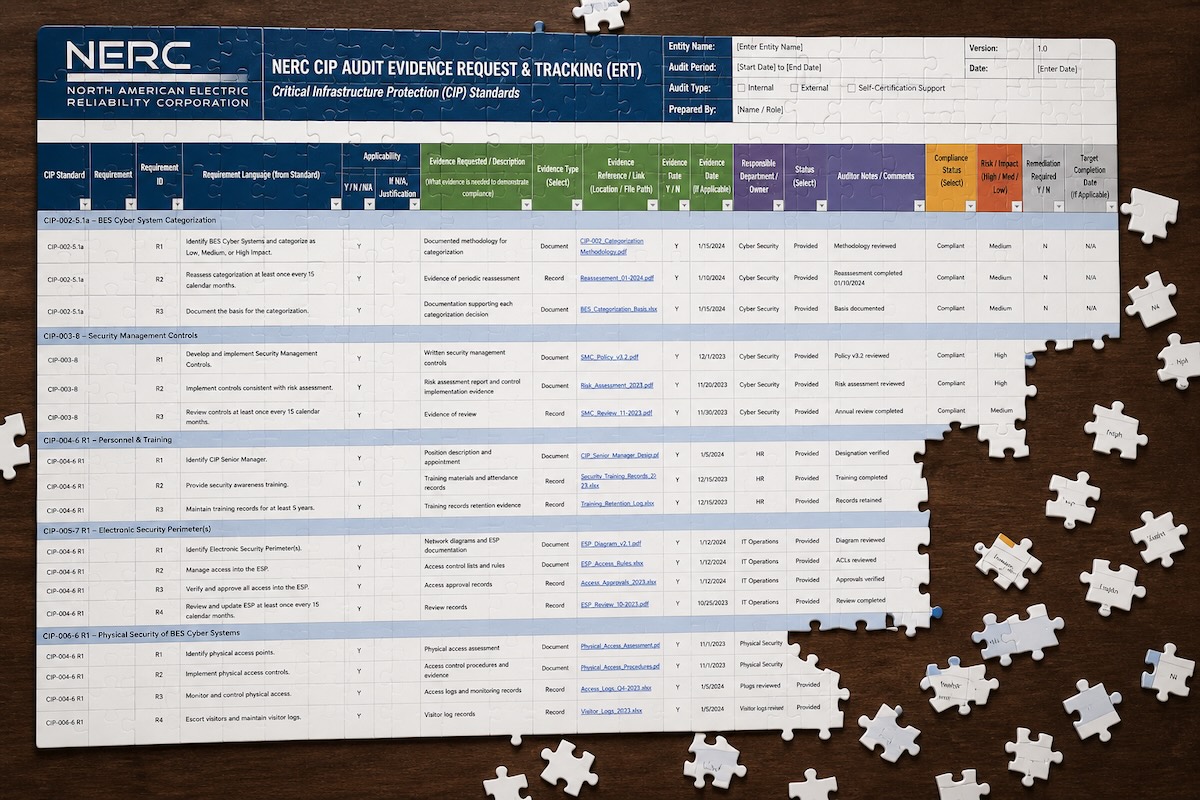
What is the NERC Evidence Request Tool (ERT)?
If you’ve spent any time in NERC compliance, you already know that audits don’t fail because companies don’t care. They fail because information is scattered, phrasing is unclear, or evidence lives in ten different places with twelve different owners.
That’s where the NERC Evidence Request Tool, better known as the ERT, comes in.
On the surface, the ERT looks like just another Excel file. No fancy interface. No glossy branding. Just rows, columns, and tabs. But calling it “just a spreadsheet” is like calling a passport “just a booklet.” Its value isn’t in how it looks. It’s in what it enables.
The ERT is how auditors and registered entities talk to each other without talking past each other.
The ERT, Explained Like a Normal Person
At its core, the ERT is a structured way for auditors to ask for proof and for entities to respond without confusion. Every reliability standard, every requirement, and every sub-requirement gets mapped to a specific place where evidence lives.
Think of it like a shared checklist that both sides agree on before the audit even starts. Auditors are saying, “Here’s exactly what we need to see.” Entities respond with, “Here’s exactly where it is.”
Without the ERT, audits feel like a scavenger hunt where the rules keep changing. With it, everyone is working from the same map.
That map matters because auditors are not inside your systems. They do not know your file structure, your naming conventions, or which SharePoint folder is “the real one.” The ERT removes assumptions and replaces them with clarity.
Why the ERT Actually Matters
NERC audits are not about paperwork for the sake of paperwork. They exist to protect the Bulk Power System. That part is serious. What becomes exhausting is when the process itself adds friction that has nothing to do with reliability.
The ERT reduces that friction.
Instead of sending long narrative explanations or dumping massive folders of documents on an auditor, the ERT requires precision. Each request ties directly to a requirement. Each response points directly to evidence.
A good ERT tells a story without drama. It says, “This control exists. This is how it operates. This is where the proof lives.”
That clarity saves time for everyone involved. Auditors move faster. Fewer follow-up questions get asked. Compliance teams spend less time clarifying and more time doing actual work.
If compliance were a courtroom, the ERT would be your evidence binder, not your closing argument. It’s about facts, not persuasion.
Finding the ERT Without Guessing
The ERT is published by NERC and maintained alongside compliance and enforcement resources. Regional Entities also distribute versions aligned with their audit processes. One detail matters more than people expect. The ERT changes. Not constantly, but enough that using an old version can create unnecessary problems.
Using and outdated ERT is like showing up to an inspection with last year’s checklist. Even if everything is technically compliant, you are now out of sync with the auditor’s expectations. Before any audit preparation begins, the first move should always be confirming that you have the current ERT from NERC or your Regional Entity. That single step avoids a surprising amount of frustration later.
Why the ERT Is Replacing the RSAW
For a long time, the Reliability Standard Audit Worksheet, or RSAW, was the main tool for audit preparation. It worked, but it reflected an older way of thinking about compliance. The RSAW narrative is slowly being replaced by the NERC ERT.
RSAWs leaned heavily on narrative explanations. Entities would write long responses describing how controls worked and then attach evidence to support those explanations. The result often felt subjective. Two entities could describe similar controls in very different ways, which made consistency difficult.
The ERT changes that dynamic.
Instead of asking entities to explain themselves in paragraphs, the ERT asks them to show their work in a structured, consistent way. Evidence is no longer buried behind prose. It is mapped directly to requirements.
This shift is one reason the industry is moving away from RSAWs. The ERT aligns better with how audits actually function today. Auditors are validating evidence, not grading essays.
We recently covered this transition in depth on the NovaSync.io blog, breaking down why the ERT is becoming the preferred mechanism and how it reflects a broader push toward efficiency and clarity in NERC compliance. The takeaway is simple. The ERT fits the modern audit far better than the RSAW ever did.
Using the ERT Without Making It Painful
The biggest mistake teams make with the ERT is treating it like a form that gets filled out at the last possible moment.
That approach turns audit prep into a fire drill. Evidence owners scramble. References get sloppy. Stress rises. Mistakes slip through.
A better way to think about the ERT is as an evidence index of your compliance program.
When controls are tested, the ERT gets updated. When procedures change, references get adjusted. When evidence moves, the link gets fixed. Nothing dramatic. Just small, consistent maintenance.
When audit notice arrives, the ERT is already telling the story. The team is polishing, not panicking.
Another mental shift helps. Write every ERT entry as if the person reading it has never met you, never seen your systems, and has thirty other entities to review that week. Because that is exactly who the auditor is.
Clarity beats cleverness every time.
Where GRC Platforms Change the Game
On its own, the ERT is a solid tool. Paired with a modern NERC GRC platform like NovaSync, it becomes something else entirely.
Most of the time spent preparing an ERT is not spent thinking. It’s spent copying, pasting, validating links, checking filenames, and making sure nothing broke between last year and this year.
That work is mechanical. Which means it is perfect for automation.
Platforms like NovaSync connect compliance controls, evidence repositories, and audit artifacts in one place. When the ERT is needed, the platform can export the required data directly into the correct format in just a few clicks.
What once took weeks of coordination now take minutes.
Instead of asking ten people for ten documents and stitching everything together by hand, compliance teams can generate an audit-ready ERT with confidence that references are current and complete.
This is where hundreds of hours can be saved during audit cycle. Not through shortcuts, but through better systems across the organization.
While the ERT remains as the official evidence submission tool, NovaSync reduces the pain of gathering, organizing, and submitting that evidence.
What the ERT Is Really Becoming
The ERT started as a way to standardize evidence requests. It is quietly becoming something more.
It is turning into a mirror of an organization’s compliance maturity.
When the ERT is clean, current, and easy to follow, it usually means controls are well understood and well managed. When it is messy and rushed, it often reflects deeper issues that go beyond documentation.
Auditors notice. Over time, entities feel it.
That is why the ERT is no longer just an audit deliverable. It is a signal.
Exporting the ERT from NovaSync GRC
The NERC Evidence Request Tool is not exciting. It will never be exciting. That’s actually the point.
Its job is to remove noise, reduce friction, and make compliance visible without theatrics. It replaces the RSAW because it fits how audits really work today. It pairs naturally with NERC GRC platforms because modern compliance cannot survive on manual efforts alone.
When used correctly, the ERT stops being something teams dread and starts being something they rely on. A clear record. A shared understanding. A calm answer when the audit question arrives. So how do you get there?
The NovaSync NERC GRC platform generates the ERT in just a couple of clicks. Compliance stops feeling like a burden when you are using the right tools for the job. NovaSync’s NERC GRC is like having a living version of the ERT. As your SMEs and compliance program evolves, NovaSync’s workflow engine drives consistent audit-ready results that you can have available at any moment.
If you haven’t explored how NovaSync can improve your compliance workflows, including filling out the NERC ERT, request a demo to see it in action.